
Reproduced from the The Steamway Cleaning Scene, Fall '94, pages 1,6.
Research Conducted for the United States Environmental Protection Agency
Confirms the Value of Hot Water Extraction Carpet Cleaning In Improving Indoor Air Quality
As Part of a Total Environmental Management And Cleaning System
A
recently conducted scientific study performed by the Research Triangle Institute
in Chapel Hill North Carolina for the United States Environmental Protection
Agency, was recently reported on as part of an effort to study the effect of
cleaning on the quality of the indoor air in buildings. This study can be
identified as follows:
Indoor
Environment Characterization of A Non-Problem Building: Assessment Of Cleaning
Effectiveness Prepared For:
United
States Environmental Criteria And Assessment Office U.S. Environmental
Protection Agency Research Triangle Park, NC 27711
EPA
Cooperative Agreement CR-815509-02-1 RTI Project Number 94U-4479-014
Prepared
By:
Research
Triangle Institute P.O. Box 12194
Research Triangle Park, North Carolina 27709-2194
In
some statements, the study is referred to as the Frank Porter Graham (FPG) study
because the building used for the study was performed at the Frank Porter Graham
Child Development Center at the University of North Carolina in Chapel Hill,
North Carolina.
Over
the next few issues of the CLEANING SCENE, we will be reprinting, with
permission, significant sections of this study. The following, reprinted with
permission. is just part of the 202 page report on the findings of this study.
The abstract defines the scope and purpose of the study.
ABSTRACT
A
study was conducted to characterize the indoor environment of a multi-floor,
multiuse, non- problem, non-complaint building through long-term sampling for
biological, chemical, and particulate pollutants: and to assess the effects of
cleaning on indoor air quality. The study protocol included five months of
"baseline" environmental measurements, a rigorous cleaning of the
entire building; and, subsequently, seven months of environmental monitoring
after implementation of an economically feasible, standard cleaning program.
Air, surface, and dust data from monitoring prior to the cleaning program were
compared with those obtained while the improved housekeeping program was in
place to assess the effectiveness of the cleaning program on the indoor
environment. Correlations between pollutants and other environmental factors are
also presented. This work involved a collaborative effort by Research Triangle
Institute, the U.S. Environmental Protection Agency's Environmental Criteria and
Assessment Office, the University of North Carolina at Chapel Hill (UNC), the
building service contractor, and commercial cleaning and carpet industries, and
their suppliers.
The
study concluded that an organized cleaning program based upon environmental
management principles and fundamental environmental protection guidelines
contributed to improved indoor air quality through reduction of total suspended
particles, total volatile organic compounds, and culturable bacteria and fungi.
(Page iii in study)
EXECUTIVE
SUMMARY
In
an earlier study, the Research Triangle Institute (RTI) monitored for bio-aerosols,
chemical and particles before and during carpet cleaning in commercial and
residential environments (Cole and Foarde, 1992). Non-complaint environments
were selected, although problems were found in two of the buildings. In general,
the pollutant levels before and during carpet cleaning were related to the
extent of routine cleaning in the building. As an extension of the research, the
current study was established to better understand and assess the effectiveness
of an economically-feasible, standard cleaning program to improve indoor air
quality in a building, and to generate an extensive database characterizing
anon- problem or "healthy" building environment. This study was
planned and conducted with extensive collaboration among personnel from RTI, the
U.S. Environmental Protection Agency, lead by the Environmental Criteria and
Assessment Office with extensive involvement by the Air and Energy Engineering
Research Laboratory, the University of North Carolina at Chapel Hill (UNC), the
building service contractor, commercial cleaning and carpet industries, and
their suppliers. This study represents an early example (which is being utilized
with increasing frequency) of extensive government, not-for-profit organization,
and industry collaboration, where industry representatives served on an advisory
committee and provided technical guidance in selected areas of key importance to
the success of the research.
After
extensive protocol development by the many collaborators, the yearlong,
environmental monitoring effort was performed at the Frank Porter Graham Child
Development Center (FPG) at the University of North Carolina, Chapel Hill, North
Carolina. The Center is a multi-disciplinary, research effort led by
pediatricians, psychologists, educators, and the health professionals who are
studying the development of normal and handicapped preschool children. This 20
year old building has four floors and is approximately 2,700 m2, 66% of which is
carpeted. There is a day care facility for 62 children, and 214 adults work with
the day care and in the offices and laboratories of the building. Two full-time
university housekeeping staffs are assigned to the building.
The environmental monitoring included bioaerosol sampling, non-floor surface biologicals, floor dust samples for mass and biologicals, aerosol particle counts, aerosol dust mass, volatile organic compounds, and comfort factors such as temperature, relative humidity, carbon monoxide, and carbon dioxide. Initially (July 1992), the building was inspected, and an extensive environmental

Col
2
During
the course of the study, several unplanned "occurrences" were
environmentally managed. They included a mold contaminated wall in a nursery
area, flooding from plumbing and roof leaks, and smoke infiltration from
neighborhood fires. When necessary, restoration was rapidly performed and each
location was monitored to ensure the bio-pollution did not amplify. Thus,
several unplanned "mini-studies" resulted and are described in various
sections of the report.
Results
of the study are compiled from detailed data in Section 6.0, 7.0, and 8.0 and
are presented in Table 1. Key findings, conclusions, and research needs follow
Table 1.
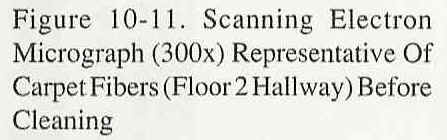
 Before
Extraction
Before
Extraction
 After Extraction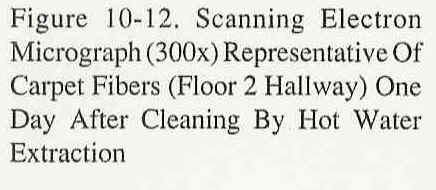
 See
the actual page by clicking the picture.
See
the actual page by clicking the picture.
SUMMARY OF MAJOR FINDINGS
Particle
Results
.
Airborne dust mass, measures as total suspended particles (TSP), provided
the most meaningful particle data and showed a statistically significant
reduction with improved cleaning.
.
Immediately after deep cleaning, carpet dust mass was reduced, particularly
on floors with the highest dust loads.
.
Soon after deep cleaning, carpet dust mass loads quickly returned to before
cleaning levels, confirming carpet as a sink or collector of particles.
.
Airborne dust mass was decreased after deep cleaning and continued
lower even though the
total
mass /rom dust in carpets soon returned to original levels.
Bio-pollutant Results: Correlations
.
Airborne levels of bio-pollutants correlated with airborne dust
mass, and the bacteria correlation is statistically significant.
.
Levels of bacteria and fungi from non-floor surfaces correlated
(statistically significant) with
airborne
levels of bacteria and fungi providing evidence that surface pollutants
can be reflective of airborne levels and airborne levels can
be reflective of surface contamination.
.
Levels of carpet dust bacteria have a statistically significant correlation
with airborne bacteria
indicated
a relationship between the two that demonstrates the need for cleaning
pollutant removal as an environmental management tool for maintaining
acceptable air quality. '
.
A yearlong study of a non-problem building showed that attention to improved
housekeeping (in conjunction with proper HVAC operation and maintenance),
resulted in sustained reduction of mean levels of:
- airborne bacteria (40%) and fungi (61 %), (Andersen sampler),
-
non-floor surface bacteria (29%) and fungi (25%),
- carpet dust bacteria (84%), fungi (93%), and endotoxin (72%).
.
Deep cleaning resulted in reduction of mean levels of:
-
airborne bacteria (58%) and fungi (25%), (Andersen sampler) - non-floor
surface bacteria (58%) and fungi (15%),
- carpet dust bacteria (76%), fungi (99%), and endotoxin (98%).
.
An organized cleaning program based upon environmental management principles
and fundamental environmental protection guidelines contributed to indoor
air quality through the reduction of total suspended particles (TSP), total
volatile organic compounds (TVOC's) and culturable bacteria and fungi.
.
While airborne pollutants increased during deep cleaning, they never reached
levels of concern to the researchers, and were shown to decrease rapidly to
levels well below the "pre- cleaning" concentrations.
.
The study data suggests the ambient, environmental pollution can be
significantly controlled through an effective and managed indoor cleaning
program.
.
Routine, non-floor, surface bacterial and fungal sampling can help identify
areas for focused cleaning, as well as provide a useful assessment of a
building's changing microbial ecology.
(Pages v-x in study)